Why windows dry with spots
When ordinary tap water dries on glass, it leaves spots. You’ve seen it on shower screens, on your car, on greenhouse panels. The reason is simple: tap water contains dissolved minerals — calcium, magnesium, sodium, a bit of iron. The water evaporates. The minerals don’t. They stay on the glass as tiny white spots.
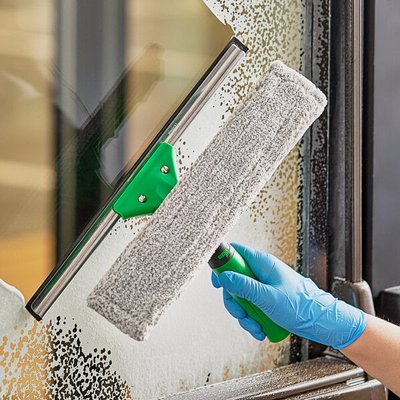
If you clean windows with tap water and let them air dry, you’ll get spotting. That’s why traditional window cleaning always involved a squeegee — to sheet the water off the glass before it could dry and leave those minerals behind.
Pure water cleaning changes the game. With pure water, you don’t need a squeegee at all. You scrub the glass with a brush, rinse it with the same water, and walk away. No spots. No streaks. Clear glass.
What pure water actually is
Pure water has had the dissolved minerals removed. Properly made pure water has a reading of 0 parts per million (PPM) on a total dissolved solids meter. Tap water in Watford is usually around 250-350 PPM.
Because there’s nothing dissolved in it, when pure water evaporates, nothing is left behind. The glass dries spot-free.
There are two main ways to produce pure water:
Reverse osmosis (RO). Tap water is forced through a very fine membrane under pressure. The membrane filters out 95-98% of dissolved minerals. It also wastes a lot of water — for every litre of pure water out, you get about 3 to 4 litres of waste water.
Deionisation (DI). Tap water passes through a tank of resin beads that absorb the remaining ions. Produces 0 PPM water but the resin eventually gets saturated and needs replacing.
Most professional vans use both — reverse osmosis as the first stage, DI resin as the polishing stage. That way the DI resin lasts a lot longer.
How a waterfed pole works
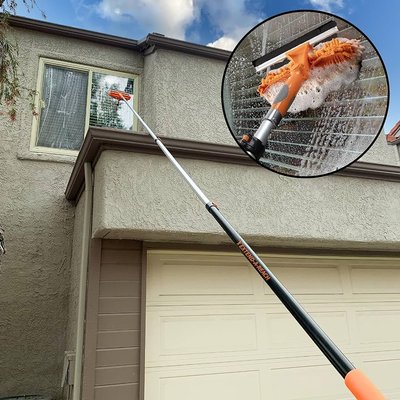
A waterfed pole is a telescopic pole with a brush on the end and a water hose running up through the middle. Pure water is pumped from a tank in the van (or from a small portable system) up through the pole to the brush. The water comes out of tiny jets next to the bristles.

To clean, you:
1. Wet the glass with water from the brush.
2. Scrub the glass with the bristles to loosen dirt.
3. Rinse the glass with more water from the brush.
4. Walk away. The glass dries spot-free.
You don’t touch the glass with a cloth. You don’t squeegee. The frames, sills and rubber seals all get cleaned at the same time as the glass.
Why it’s better than traditional cleaning
The finish is better. Pure water dries clearer than any squeegee method. Glass cleaned properly with pure water actually sparkles in a way that squeegee-cleaned glass doesn’t quite match.
You clean the frames at the same time. The brush washes the PVC or painted frames around each window. Tradesmen call it “frame wash” and customers love it — your window surrounds come out looking brand new.
You can reach higher up. Waterfed poles extend to 6, 8, 12, even 22 metres. That means three-storey houses and awkward roof windows can all be done from the ground.
It’s safer. No ladders, no balancing on sills, no working above head height with a bucket. The whole job is done from the ground.
It’s quicker on repeat visits. Once the frames and seals are clean, subsequent visits are very fast. The brush just needs to wash the glass.
It stays cleaner for longer. This sounds counter-intuitive, but pure water actually reduces the rate at which new dirt sticks to the glass. There’s no mineral or soap residue left to attract dust.
Is there anything pure water can’t do?
A few situations where pure water isn’t the right tool:
Internal window cleaning. Pure water on indoor windows creates the same dripping and splash problems as any other wet method. Most professionals use a squeegee or microfibre indoors.
Very greasy or oily windows. Pure water is mildly acidic and a good general cleaner, but it doesn’t cut through heavy grease. Kitchen windows over a hob sometimes need a traditional wash first.
Stickers and paint. Pure water won’t remove glue residue or paint splashes. You’ll still need solvent and a blade for those.
Hard water stains that have already etched in. If mineral staining has been there for years and has actually etched into the glass surface, pure water will clean the windows but won’t undo the etching. That needs mechanical polishing or glass replacement.
Can you do this at home?
Yes. Home waterfed pole kits have come down a lot in price. A basic setup with a resin-only DI filter connects to your garden hose. The water flows through the filter, comes out pure, and feeds up through the pole to the brush.
Expect to pay £150 to £300 for a decent starter kit. You’ll also need to budget for replacement DI resin every year or so, which is around £30 to £50 per refill for a domestic user.
For the keen DIY user with a two-storey home, a waterfed pole setup is genuinely transformative. You can do the whole front and back of the house in an hour, with no ladders.
The cost of being a professional
Just so you know what’s in my van:
- 600 litre water tank
- Reverse osmosis and DI combined purification system
- Battery-powered pump with flow controller
- Three different waterfed poles (6m, 10m and 22m)
- Replacement brushes, jets, hoses and tubes
- A TDS meter for checking water quality
The full setup is a significant investment. Customers are paying for that kit, for the training to use it safely, and for the years of experience that go with it.
That’s not a sales pitch — it’s just the reality of why a professional pure water clean looks noticeably different to a home DIY pure water clean. More experienced technique, better kit, better filtration. The cost of a regular professional service reflects that.
Will my windows really be cleaner than the old days?
Honestly, yes. The results from a proper pure water clean on well-maintained glass are better than almost anything that was possible with traditional cloth-and-squeegee methods. Customers who switch from a traditional cleaner to a pure water cleaner often say their windows haven’t looked this good since the day they were installed.
And the environmental side is worth a mention too. No chemical cleaners, no detergents washing down the drain, no scented sprays. Just filtered water doing all the work.
Need a professional pure water clean?
I cover Watford and all the surrounding areas with a proper pure water system. Free quote, no obligation, and I’ll always do the first clean at a fair price so you can see the results before committing to anything regular. Get in touch by phone or WhatsApp — I’ll be happy to come and take a look.